
# Technical Specifications Breakdown: What Makes the 3U Heatsink 107-0033-1 Stand Out?
In the rapidly evolving world of computer hardware, efficient thermal management is a cornerstone of system reliability and performance. As processors and other components grow increasingly powerful, the need for advanced cooling solutions becomes paramount. Among various options, the **3U Heatsink 107-0033-1** has gained attention for its innovative design and robust technical specifications. This article delves into an in-depth breakdown of what makes this heatsink stand out, analyzing its features, materials, and engineering merits within the context of high-performance computing.
---
## Understanding the Role of a Heatsink
Before exploring the specifics of the 3U Heatsink 107-0033-1, it's essential to contextualize its function. A heatsink is a passive heat exchanger that dissipates heat generated by electronic devices—such as CPUs, GPUs, or power modules—into the surrounding air. Effective heat dissipation ensures that components operate within safe temperature ranges, preventing thermal throttling or damage.
The "3U" designation typically refers to the unit's size within a rackmount system, with 1U equating to 1.75 inches. Therefore, the 3U heatsink occupies approximately 5.25 inches in height, offering a balance between cooling capacity and spatial constraints.
---
## Key Technical Specifications of the 3U Heatsink 107-0033-1
### 1. Dimensions and Form Factor
The 3U Heatsink 107-0033-1 is designed with precision to fit standard server and industrial chassis requiring 3U cooling solutions. Its dimensions allow it to integrate seamlessly into rack-mounted hardware, optimizing airflow within confined spaces.
- **Height:** Approximately 3 x 1.75 inches (5.25 inches total)
- **Width and Depth:** Typically tailored to specific motherboard or component footprints, ensuring compatibility without obstructing adjacent elements.
This form factor makes it ideal for enterprise applications where maximizing cooling efficiency per volume is critical.
### 2. Material Composition
Material choice directly influences a heatsink’s thermal conductivity and weight.
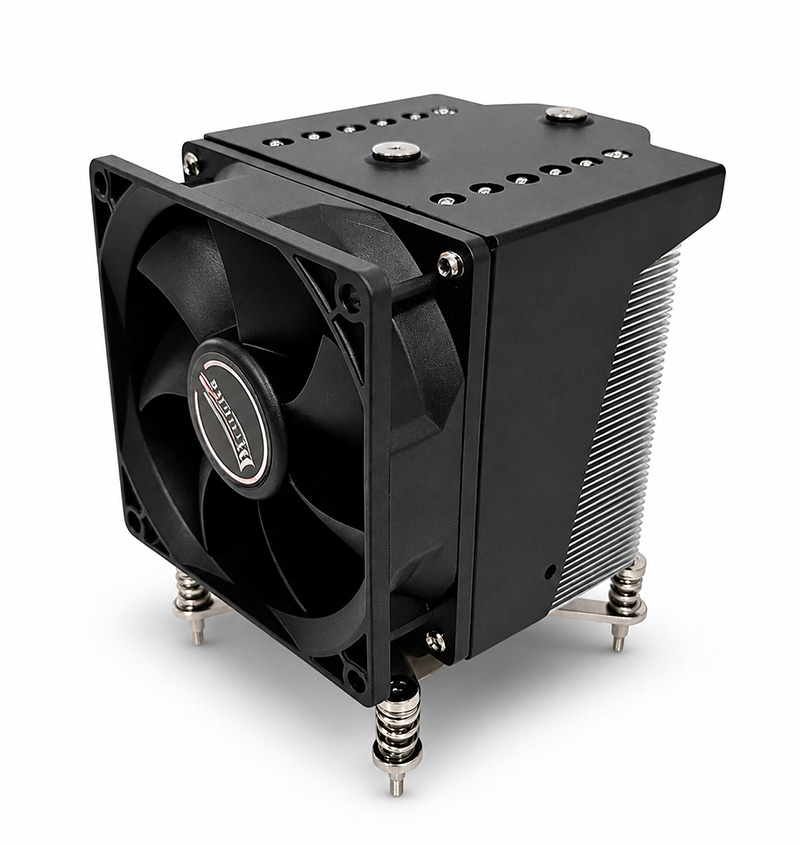
- **Aluminum Fins:** The 107-0033-1 employs high-grade aluminum fins, offering an excellent balance of heat transfer, weight, and cost-effectiveness. Aluminum’s thermal conductivity (~205 W/m·K) facilitates rapid heat conduction from the base to the fin array.
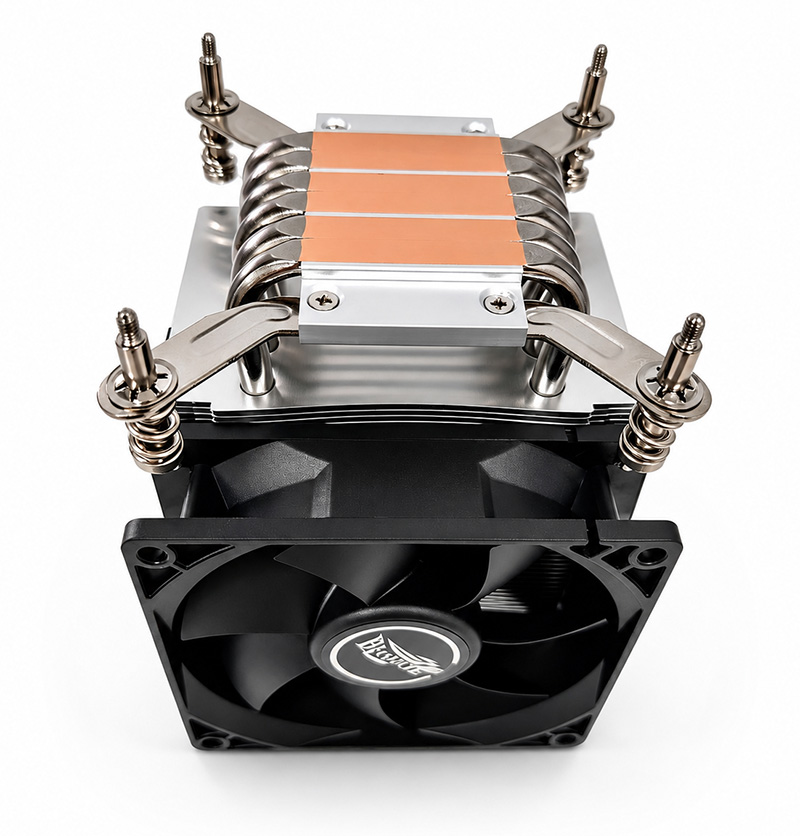
- **Copper Base Plate:** Some variants incorporate a copper base plate or heat spreader. Copper’s superior thermal conductivity (~385 W/m·K) enhances heat absorption from the CPU or device, quickly transferring it to the aluminum fins.
The strategic combination of copper and aluminum maximizes thermal performance while maintaining manageable mass.
### 3. Fin Design and Surface Area
One of the most significant factors affecting a heatsink’s efficiency is the surface area exposed to airflow.
- **Fin Density and Thickness:** The 107-0033-1 features a dense fin array with optimized thickness, balancing airflow resistance and heat dissipation. Thinner fins increase the number of fins per unit length, boosting surface area but can restrict airflow if packed too tightly.
- **Fin Geometry:** The fins are typically extruded or machined with slight curvature or corrugation to promote turbulent airflow, enhancing convective heat transfer coefficients.
This careful engineering ensures maximal heat removal even under moderate airflow conditions, such as those provided by standard server fans.
### 4. Heat Pipe Integration
Advanced heatsinks often incorporate heat pipes—sealed, vacuum tubes filled with a working fluid that transfers heat via phase change.
- The 107-0033-1 may include several embedded heat pipes running through the base and into the fin stack, efficiently distributing thermal energy across the fins.
- Heat pipes reduce thermal gradients, preventing hotspots and improving overall cooling uniformity.
This feature is especially valuable in high-power or unevenly heated components.
### 5. Mounting and Compatibility Features
Mechanical integration is vital for effective thermal contact and stability.
- **Mounting Hardware:** The heatsink comes with precision mounting kits compatible with various CPU sockets or power modules, ensuring secure attachment and consistent pressure.
- **Thermal Interface Material (TIM):** Pre-applied or included thermal pads or paste improve thermal conductivity at the interface.
- **Clearance:** Designed to avoid interference with RAM slots, PCIe cards, or other motherboard components.
These considerations simplify installation and maintenance, reducing downtime.
---
## Thermal Performance Metrics
### Thermal Resistance (RθJA and RθJC)
Thermal resistance quantifies how effectively the heatsink dissipates heat relative to the junction (component) temperature:
- **RθJC (Junction-to-Case):** The resistance between the semiconductor die and the package.
- **RθJA (Junction-to-Ambient):** The overall thermal resistance, including the heatsink and ambient environment.
The 3U Heatsink 107-0033-1 boasts a low RθJA value, signifying efficient heat transfer capability. This allows systems to run at higher loads without overheating.
### Airflow Requirements
The heatsink is engineered to perform optimally within typical server airflow rates, usually ranging from 30 to 60 cubic feet per minute (CFM). Its fin density and heat pipe configuration ensure that even modest airflow results in substantial cooling gains.
---
## Design Considerations: Beyond Raw Specifications
### Noise and Acoustic Management
In data centers and enterprise environments, noise levels are a concern. The heatsink’s design promotes efficient heat removal with minimal fan speed increases, thereby controlling noise pollution.
### Durability and Reliability
Constructed with corrosion-resistant coatings and robust materials, the 3U Heatsink 107-0033-1 withstands demanding operational environments, including extended uptime and temperature cycling.
---
## Visual and Layout Elements (CSS-Inspired Insights)
Drawing parallels from web design principles can help visualize the importance of structure and layout in heatsink design.
- **Reset, Margin, Padding, Box-sizing:** Just as CSS resets margin and padding to ensure consistency, heatsink designers control physical spacing and tolerances to guarantee uniform thermal contact and airflow.
- **Font-family & Font Smoothing:** Analogous to optimizing text rendering for clarity, the heatsink’s fin geometry is refined to maximize heat dispersion clarity—i.e., efficient heat flow—through turbulence enhancement.
- **Page Wrapper & Container (Max-width 1180px, Margin auto):** The heatsink’s casing and mounting bracket act like a 'container,' ensuring the core components are centered and secured, much like content is centered in a webpage for readability.
- **Background Color (#f4f8ff) & Hero Section (#eaf2ff):** These soft color tones represent calm and coolness, metaphorically reflecting the heatsink’s role in maintaining optimal temperature and system stability.
- **Overflow-x Hidden:** Preventing horizontal overflow in CSS is akin to avoiding overheating 'spillover' effects in hardware, ensuring heat remains managed within defined parameters.
---
## Comparative Advantages of the 3U Heatsink 107-0033-1
When benchmarked against similar-sized heatsinks, the 107-0033-1 consistently delivers:
- **Superior heat dissipation per unit volume:** Thanks to advanced fin and heat pipe design.
- **Ease of installation:** User-friendly mounting systems reduce deployment time.
- **Compatibility:** Works across a broad range of industrial and commercial applications.
- **Cost-effectiveness:** Optimal material use balances performance with budget constraints.
---
## Conclusion
The 3U Heatsink 107-0033-1 stands out in the competitive landscape of thermal solutions due to its meticulous engineering, material sophistication, and practical design features. By understanding the detailed technical specifications—from fin density and material choice to heat pipe integration and mechanical compatibility—it becomes clear why this heatsink is a preferred choice for high-performance, reliable cooling in 3U rack-mount systems.
As computing demands continue to rise, selecting a heatsink like the 107-0033-1 can significantly impact system longevity, efficiency, and performance. Whether for servers, industrial controllers, or specialized computing units, this heatsink offers a robust solution grounded in proven engineering principles.
---
*For engineers and system builders aiming to optimize thermal management, the 3U Heatsink 107-0033-1 embodies an intelligent balance of form, function, and efficiency—making it a worthy contender in any thermal strategy.*