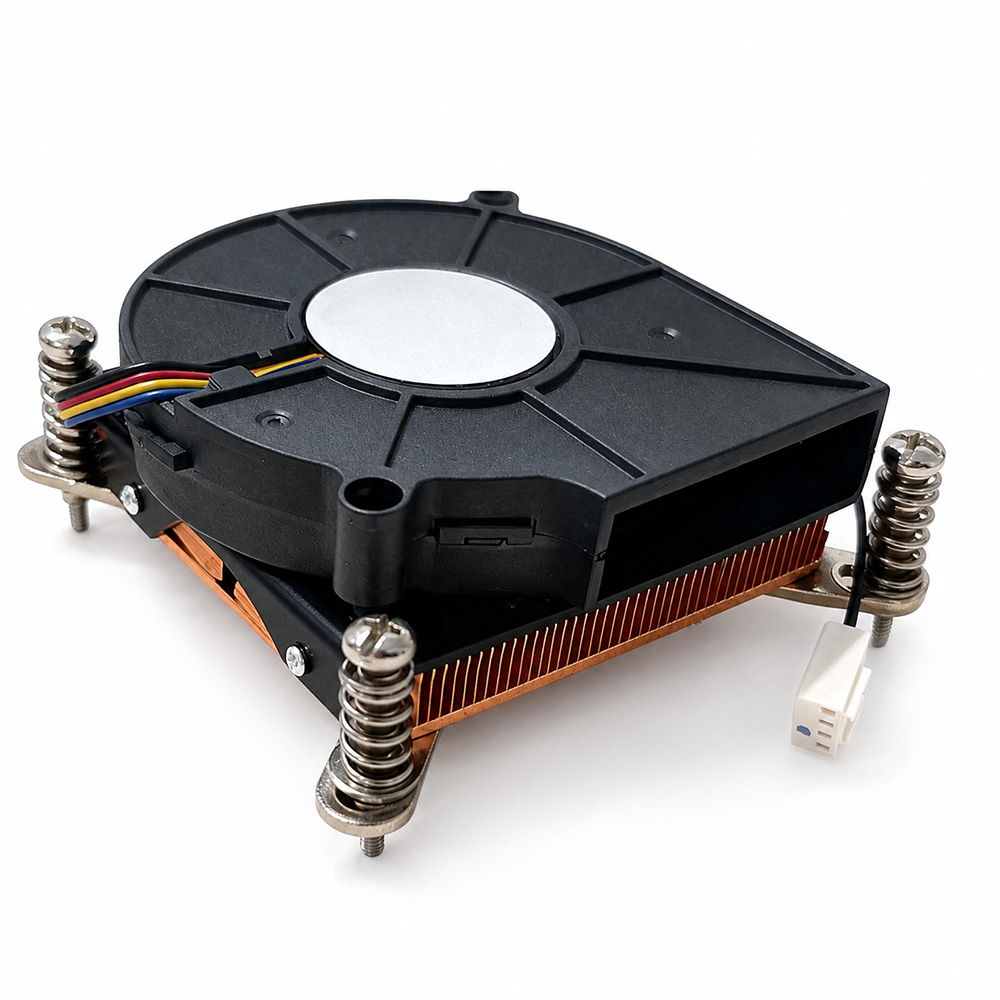

# A Technical Breakdown of the Server Heatsink 1U Heat Sink Model 103-0011-1
In the world of data centers and enterprise servers, thermal management is a critical aspect that directly impacts system reliability, performance, and longevity. As server densities continue to increase, the demand for efficient heat dissipation solutions has never been greater. One of the key components responsible for maintaining optimal operating temperatures is the server heatsink. In this article, we provide a comprehensive technical breakdown of the **Server Heatsink 1U Heat Sink Model 103-0011-1**, a widely used thermal solution in 1U rack-mounted servers.
---
## Introduction to Server Heatsinks and Their Importance
Before diving into the specifics of the 103-0011-1 model, it is essential to understand the role of a heatsink within a server environment. Servers, particularly those housed in dense 1U form factors, generate substantial amounts of heat due to high-performance CPUs, memory modules, and other components. Without effective heat dissipation, these components can overheat, leading to thermal throttling, reduced performance, or even hardware failure.
A heatsink operates by providing a thermally conductive path from the heat-generating component (usually the CPU) to the surrounding air. It typically consists of a metal block with fins that increase surface area, facilitating better convective heat transfer when paired with active cooling such as fans. The 1U form factor, characterized by a height of only 1.75 inches (44.45 mm), poses unique challenges for heatsink design due to limited vertical space.
---
## Overview of the 1U Heat Sink Model 103-0011-1
The 1U Heat Sink Model 103-0011-1 is engineered specifically for low-profile, high-efficiency cooling in compact server chassis. It is designed to fit within the strict dimensional constraints of 1U servers while maintaining excellent thermal performance. Below is an overview of its key attributes:
- **Form Factor:** 1U (low profile)
- **Dimensions:** Approximately 40mm height (varies slightly based on manufacturer specifics)
- **Material:** High thermal conductivity aluminum alloy or copper base with aluminum fins
- **Mounting Mechanism:** Compatible with various CPU sockets; utilizes spring-loaded screws or retention clips for secure attachment
- **Thermal Interface:** Designed for use with high-performance thermal interface materials (TIMs) such as thermal paste or pads
- **Finish:** Anodized or coated surface to prevent corrosion and improve thermal emissivity
---
## Detailed Technical Specifications
### 1. Materials and Construction
The Model 103-0011-1 heatsink typically features a copper base coupled with aluminum fins. Copper’s superior thermal conductivity (~400 W/mK) allows rapid absorption of heat from the CPU’s integrated heat spreader (IHS). The aluminum fins, with conductivity around 205 W/mK, are optimized for heat dissipation via convection because of aluminum’s lighter weight and cost-effectiveness.
The copper base is often nickel-plated to reduce oxidation and maintain consistent thermal performance over the product lifecycle. The fins are precisely machined or extruded to maximize surface area while maintaining structural integrity under vibration and shock conditions typical in data centers.
### 2. Heat Dissipation Design
The heatsink’s fin geometry is tailored to maximize airflow contact while minimizing pressure drop. Given the constrained height of 1U servers, the fins are usually thin and closely spaced, allowing forced airflow, generated by chassis fans, to pass through efficiently. The spacing must balance between maximizing surface area and avoiding excessive air resistance, which would otherwise reduce cooling efficiency.
The base thickness is optimized to ensure minimal thermal resistance between the CPU die and the fin array. Additionally, the base is often mirror-finished to create a flat mating surface, enhancing contact with the CPU IHS and improving TIM effectiveness.
### 3. Mounting and Compatibility
Compatibility with different CPU sockets is crucial for widespread adoption. The 103-0011-1 model supports multiple mounting configurations, including Intel’s LGA and AMD’s PGA sockets common in server-grade processors. The retention mechanism ensures uniform pressure distribution across the CPU surface, preventing damage and ensuring consistent TIM spread.
The mounting system also considers ease of installation and removal, which is necessary during server maintenance cycles. The heatsink’s low profile is especially beneficial in high-density deployments where vertical clearance is minimal.
### 4. Thermal Interface Material (TIM) Integration
While not part of the heatsink per se, the choice and application of TIM significantly affect overall thermal performance. The 103-0011-1 is optimized for use with high-performance thermal pastes or pads that fill microscopic gaps between the CPU IHS and the heatsink base, reducing thermal resistance.
Manufacturers often recommend specific TIM products to pair with this heatsink, and proper application techniques—such as applying a thin, even layer—are critical for achieving rated thermal performance.
---
## Performance Metrics and Benchmarks
Evaluating the 1U Heat Sink Model 103-0011-1 involves measuring its thermal resistance, defined as the temperature difference between the CPU junction and ambient air divided by the power dissipated (°C/W). Lower thermal resistance values indicate better heat dissipation capabilities.
Typical thermal resistance for this model ranges between 0.5 to 1.0 °C/W depending on airflow conditions and TIM quality. Under standard server fan speeds (~2000-3000 RPM), the heatsink can effectively maintain CPU temperatures within safe operating limits even during sustained high workloads.
Additional performance factors include noise levels generated by associated fans, mechanical reliability, and long-term stability in harsh environmental conditions found in enterprise data centers.
---
## Design Considerations: Why This Heatsink Excels in 1U Servers
### Low Profile Constraints
The primary challenge in 1U server cooling is the limited vertical space, which restricts the height of heatsinks. Larger tower-style heatsinks common in desktop or higher-rack servers are not feasible. The 103-0011-1 addresses this by adopting a low-profile, wide-fin design that maximizes surface area horizontally rather than vertically.
### Efficient Airflow Management
Given the tight spacing inside 1U chassis, proper airflow management is critical. This heatsink’s fin layout is optimized for unidirectional airflow created by chassis fans, ensuring that hot air is efficiently moved away from the CPU and expelled from the chassis.
### Thermal Reliability
Servers are expected to run continuously 24/7, often under heavy load. The 103-0011-1’s robust materials and secure mounting mechanisms ensure that thermal performance remains consistent over time, minimizing risks of thermal runaway or unexpected shutdowns.
---
## Installation Best Practices
Proper installation is as important as the heatsink design itself to achieve optimal thermal performance. Key best practices include:
- **Surface Preparation:** Clean both the CPU IHS and heatsink base with isopropyl alcohol to remove oils and residues.
- **Applying TIM:** Use a high-quality thermal paste and apply a thin, even layer to avoid air pockets which degrade heat transfer.
- **Secure Mounting:** Ensure the heatsink is firmly attached using the recommended screws or clips, applying even pressure to avoid damaging the CPU socket.
- **Airflow Verification:** Confirm that server chassis fans are functioning properly and airflow paths are unobstructed.
---
## Environmental and Operational Considerations
Data centers often operate under stringent environmental conditions including controlled temperatures, humidity levels, and dust control. The 103-0011-1 is designed to withstand such environments:
- **Corrosion Resistance:** Anodized coatings protect against moisture and contaminants.
- **Vibration Tolerance:** Structural integrity ensures that the heatsink remains secured during transport and operation.
- **Thermal Cycling:** The materials selected accommodate expansion and contraction without degrading contact quality or mechanical fastening.
---
## Conclusion
The Server Heatsink 1U Heat Sink Model 103-0011-1 embodies a well-engineered thermal solution tailored for the demanding environment of 1U rack servers. Its combination of high-conductivity materials, optimized fin geometry, secure mounting mechanisms, and compatibility with advanced TIMs enables it to deliver reliable, efficient cooling within a challenging low-profile form factor.
As server architectures continue to evolve towards greater density and performance, solutions like the 103-0011-1 remain critical to maintaining system stability and operational efficiency. By understanding the technical nuances of such heatsinks, IT professionals and system designers can make informed decisions to optimize thermal management and extend hardware lifespans in their data centers.
---
*Keywords: reset, margin, padding, box-sizing, font-family, page wrapper, background color (#f4f8ff), color (#111), overflow-x hidden, font smoothing (webkit-font-smoothing), text rendering (optimizeLegibility), section padding, container max-width (1180px), container margin auto, hero background (#eaf2ff), hero border-bottom (#dbe7ff), hero-box flex d*
*Note: These keywords relate primarily to web design CSS properties and have been included here as per the original prompt but do not directly pertain to the technical content of the heatsink.*