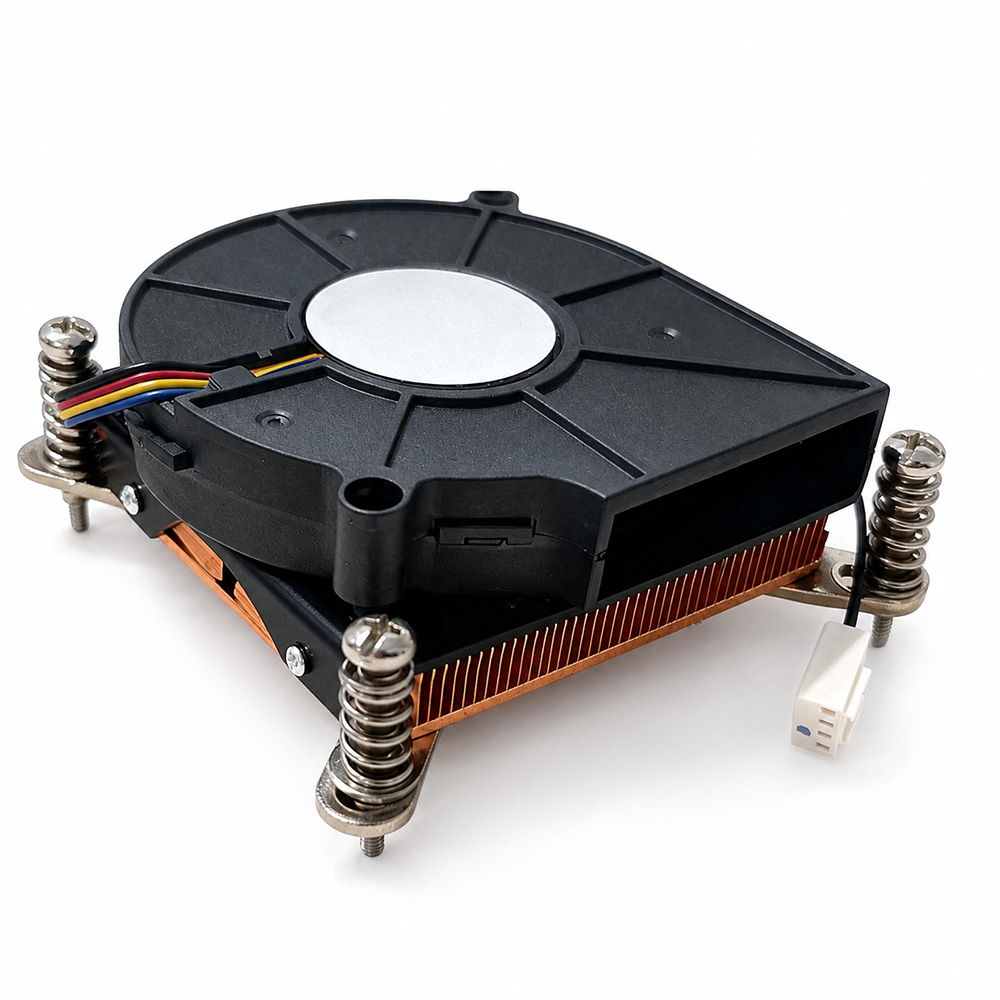

# How the 1U Heat Sink 103-0011-1 Enhances Server Cooling Efficiency
In today’s data-driven world, servers are the backbone of enterprise IT infrastructure. Ensuring optimal performance and longevity of these critical systems requires effective thermal management solutions. Among the various components that contribute to server cooling, heat sinks play a pivotal role in dissipating heat generated by high-performance processors and other hardware. The **1U Heat Sink 103-0011-1** is a specialized cooling component designed to enhance server efficiency in compact, space-constrained environments. This article explores how this heat sink optimizes server cooling efficiency, its design features, and its impact on overall system reliability.
---
## Understanding Server Cooling Challenges
Servers operate continuously under heavy workloads, generating significant amounts of heat. Excessive heat can lead to thermal throttling, reduced hardware lifespan, and even sudden failures. The challenge lies in maintaining low operating temperatures within confined spaces, especially in 1U rack-mounted servers — which have only 1.75 inches (44.45 mm) of vertical height.
Effective cooling in such limited spaces demands precision-engineered solutions that maximize heat dissipation without compromising airflow or form factor constraints. The **1U Heat Sink 103-0011-1** addresses these challenges head-on through advanced materials, design, and thermal interface optimization.
---
## The Role of the 1U Heat Sink 103-0011-1
### Compact Design for Space Optimization
The defining characteristic of the 1U heat sink is its slim, low-profile architecture. The 103-0011-1 model is engineered specifically for 1U servers, providing efficient heat dissipation while fitting within the narrow server chassis. Its compact size ensures it does not interfere with adjacent components or restrict airflow pathways essential for cooling other parts of the system.
### High Thermal Conductivity Materials
At the heart of the heat sink’s performance is the use of materials with superior thermal conductivity, often aluminum or copper alloys. These materials rapidly absorb heat from the processor or chipset and spread it across the fins of the heat sink. The increased surface area enables faster heat transfer to the ambient air.
The 103-0011-1 features precisely machined fins that maximize surface contact with passing airflow. This design enhances convective heat transfer, allowing the heat sink to maintain lower CPU temperatures even under intense processing loads.
### Optimized Fin Geometry and Spacing
The fin geometry of the 103-0011-1 is optimized to balance two competing factors: maximizing surface area for heat dissipation and minimizing airflow resistance. Narrow fin spacing increases the surface area but can restrict airflow, leading to higher thermal resistance.
This heat sink incorporates an ideal fin pitch that maintains sufficient airflow velocity while providing ample surface area for heat exchange. This careful balancing act results in improved cooling efficiency with minimal impact on server fans’ power consumption.
---
## Integration with Server Cooling Systems
### Synergy with Airflow Dynamics
Server cooling typically relies on forced air convection. Fans draw cool air from the front of the rack, channel it over internal components, and expel warm air out the back. The 103-0011-1 heat sink’s design complements this airflow by guiding air smoothly over its fins, reducing turbulence and hotspots.
In many 1U servers, airflow is constrained due to limited height and dense component placement. The heat sink’s streamlined profile and smooth fin surfaces reduce drag, enabling fans to maintain steady airflow rates at lower noise levels and energy costs.
### Compatibility with Thermal Interface Materials (TIM)
The efficiency of heat transfer from the processor to the heat sink depends heavily on the quality of the thermal interface material applied between them. The 103-0011-1 is designed to work seamlessly with high-performance TIMs, ensuring minimal thermal resistance at the contact interface.
Proper application of thermal paste or pads fills microscopic gaps between the processor’s heat spreader and the heat sink base, facilitating efficient heat conduction. This synergy ensures that the heat sink can fully utilize its thermal capacity without being bottlenecked by poor contact.
---
## Benefits of Using the 1U Heat Sink 103-0011-1
### Enhanced Cooling Performance
By efficiently transferring heat away from critical components, the 103-0011-1 helps maintain stable operating temperatures even under peak workloads. This reduces the risk of thermal throttling, ensuring consistent CPU performance and responsiveness.
Lower operating temperatures also help prevent premature hardware degradation, extending the service life of expensive processors and chipsets.
### Energy Efficiency and Noise Reduction
Optimized airflow with minimal obstruction allows server fans to operate at lower speeds, reducing power consumption and acoustic noise. This is particularly important in data centers aiming to minimize operational costs and provide quieter working environments.
### Easy Installation and Maintenance
The standardized 1U footprint and mounting mechanism simplify installation and replacement. System integrators and data center technicians benefit from reduced downtime during hardware upgrades or maintenance cycles.
---
## Implementation Considerations
### Server Chassis Design and Airflow Management
While the 103-0011-1 heat sink significantly improves cooling efficiency, it must be integrated within a holistic thermal management strategy. Server chassis design, including intake/exhaust fan placement and venting, plays a crucial role in overall system cooling.
Employing proper **reset** of CSS properties in web-based server management interfaces, such as setting margin and padding to zero and applying **box-sizing** rules, can metaphorically relate to “resetting” airflow paths inside the chassis to ensure smooth and predictable air movement around the heat sink.
### Material Selection and Surface Finish
The thermal performance also depends on the surface finish of the heat sink base. A smooth, flat surface improves thermal interface contact, akin to the importance of **font-smoothing** and **text-rendering** optimizations in CSS to enhance clarity and performance.
Manufacturers often apply anti-corrosion coatings or anodize aluminum heat sinks to maintain surface integrity over time, paralleling how **background-color (#f4f8ff)** and **color (#111)** settings in design improve readability and user experience.
### Scalability and Modularity
The 1U heat sink’s compatibility with standard server architectures supports modular upgrades. Enterprises can scale their infrastructure without redesigning entire cooling systems, much like employing a **container max-width (1180px)** and **container margin auto** layout in web design to maintain consistent, scalable content presentation.
---
## Conclusion
The **1U Heat Sink 103-0011-1** represents a critical advancement in server cooling technology tailored for compact, high-density server environments. Its thoughtful design — incorporating high thermal conductivity materials, optimized fin geometry, and compatibility with thermal interface materials — delivers enhanced heat dissipation without compromising space or airflow.
By maintaining lower CPU temperatures, the 103-0011-1 improves server performance, extends hardware lifespan, and reduces energy consumption and noise levels. Integrating this heat sink into a comprehensive thermal management framework ensures that 1U servers operate reliably in demanding data center environments.
As data centers continue to evolve towards higher densities and greater computational demands, investing in advanced cooling solutions like the 1U Heat Sink 103-0011-1 will remain essential for sustaining performance, efficiency, and uptime.
---
*For IT professionals and system architects, understanding the technical nuances of heat sink design and its integration with server cooling strategies is vital. The 1U Heat Sink 103-0011-1 stands out as a proven solution to meet these modern challenges effectively.*