
# Comparing the 2U Heatsink 104-0046-1 with Other Server Cooling Solutions
In the rapidly evolving world of data centers and enterprise IT infrastructure, efficient thermal management remains a critical factor in ensuring server reliability and performance. As servers become more powerful and densely packed, selecting the right cooling solution is paramount to maintaining optimal operating temperatures while balancing noise levels, energy consumption, and physical space constraints.
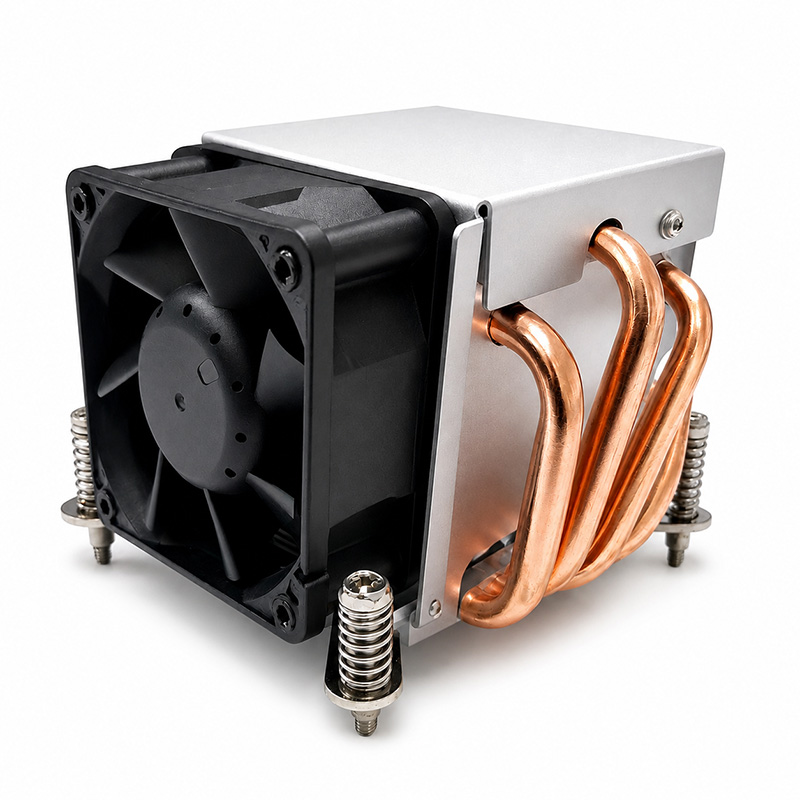
Among various options, the **2U Heatsink 104-0046-1** has garnered attention for its specific design tailored to mid-height rack servers. This article provides an in-depth comparison of the 2U Heatsink 104-0046-1 against other prevalent server cooling solutions, unpacking its advantages, limitations, and ideal use cases. Throughout the discussion, we also touch on relevant technical considerations such as airflow dynamics, heat dissipation efficiency, and integration flexibility within server chassis.
---
## Understanding Server Cooling: The Basics
Before delving into the specifics of the 2U Heatsink 104-0046-1, it is essential to understand the foundational principles of server cooling:
- **Heat Dissipation:** Servers generate heat primarily from CPUs, GPUs, memory modules, and storage devices. Effective cooling must remove this heat to prevent thermal throttling or hardware failure.
- **Airflow Management:** Proper airflow ensures that cool air reaches heat sources and hot air is expelled efficiently.
- **Space Constraints:** Rack unit heights (1U, 2U, 4U) dictate the maximum height of cooling components.
- **Power Consumption and Noise:** Cooling solutions should minimize energy usage while maintaining acceptable noise levels, especially in office environments.
### Common Types of Server Cooling Solutions
1. **Passive Heatsinks:** Rely solely on conduction and natural convection to dissipate heat; generally used for low-power components.
2. **Active Heatsinks with Fans:** Combine heatsinks with attached fans to enhance airflow and heat removal.
3. **Liquid Cooling Systems:** Utilize coolant circulation to transfer heat away from components more efficiently.
4. **Immersion Cooling:** Encase servers in dielectric fluids that absorb heat directly.
5. **Hybrid Solutions:** Integrate multiple cooling techniques for high-performance computing environments.
---
## The 2U Heatsink 104-0046-1: An Overview
The **2U Heatsink 104-0046-1** is designed explicitly for servers housed within a 2U rack unit form factor. Key features include:
- **Optimized Size:** Fits precisely within the 2U height restriction (~3.5 inches), allowing for effective cooling without compromising server density.
- **Material Composition:** Often manufactured using high thermal conductivity materials such as copper or aluminum, sometimes with anodized coatings to improve heat transfer.
- **Fin Design:** Engineered with fins that maximize surface area to enhance passive heat dissipation.
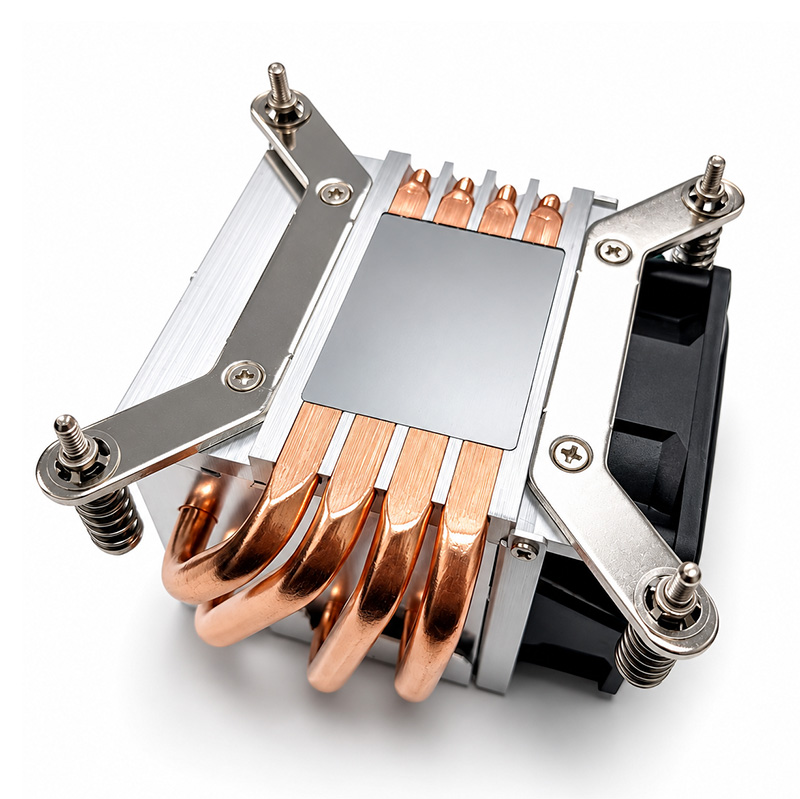
- **Compatibility:** Designed for certain CPU socket types and motherboards, ensuring secure mounting and thermal interface contact.
This heatsink's primary role is to provide a balance between size constraints and effective thermal management for mid-density server configurations.
---
## Performance Comparison with Other Cooling Solutions
### 1. **Passive vs. Active Cooling**
The 2U Heatsink 104-0046-1 typically operates as a passive or semi-passive component, often paired with chassis fans to facilitate airflow. Compared with **active heatsinks** that integrate dedicated fans:
- **Thermal Efficiency:** Active heatsinks generally offer superior heat dissipation due to forced airflow directly over the fins. However, the 2U Heatsink 104-0046-1 can achieve adequate cooling in well-ventilated chassis.
- **Noise Levels:** Passive configurations are quieter as they lack moving parts. When paired with chassis fans, noise depends on fan RPM.
- **Reliability:** Fewer moving parts mean less risk of mechanical failure.
### 2. **2U Heatsink vs. Larger 4U/6U Heatsinks**
Larger heatsinks designed for 4U or 6U servers have more substantial fin arrays and larger surface areas, enabling higher heat dissipation:
- **Cooling Capacity:** Larger heatsinks handle higher TDP (Thermal Design Power) processors better due to increased surface area.
- **Space Utilization:** The 2U Heatsink 104-0046-1 offers better server density by occupying less vertical space, crucial in space-constrained data centers.
- **Flexibility:** The 2U heatsink supports environments where rack space is at a premium but with moderate power CPUs.
### 3. **Comparison with Liquid Cooling Solutions**
Liquid cooling systems are increasingly popular in high-performance computing and dense server clusters:
- **Thermal Performance:** Liquid cooling surpasses air-based heatsinks in removing large amounts of heat quickly.
- **Installation Complexity:** The 2U Heatsink is simpler to install and maintain compared to liquid systems that require pumps, tubing, and coolant management.
- **Cost:** Air-based heatsinks like the 104-0046-1 are generally more cost-effective upfront and over the server’s lifecycle.
- **Risk Factors:** Liquid systems carry risks of leaks, which are absent in air-cooled setups.
### 4. **Immersion and Hybrid Cooling**
While immersion and hybrid cooling solutions offer cutting-edge advantages, their deployment is often limited to niche applications due to infrastructure and cost considerations:
- The 2U Heatsink remains a practical choice for traditional data centers focusing on standard rack-mounted servers.
- Immersion cooling usually requires custom server designs incompatible with standard heatsinks like the 104-0046-1.
---
## Technical Considerations in Selecting the 2U Heatsink 104-0046-1
### Compatibility and Integration
- **CPU Socket and Motherboard Layout:** The heatsink must match the CPU socket type and maintain clearance for RAM slots and expansion cards.
- **Chassis Airflow Design:** Proper alignment with chassis fans ensures effective heat removal.
- **Thermal Interface Material (TIM):** High-quality TIM improves heat transfer between the CPU and heatsink base.
### Thermal Performance Metrics
- **Thermal Resistance (°C/W):** Lower values indicate better heat dissipation.
- **TDP Support:** The 2U Heatsink 104-0046-1 is rated for CPUs with moderate to high TDP values (e.g., 95W - 150W), making it suitable for mainstream server processors.
- **Airflow Requirements:** Ensuring sufficient airflow (measured in CFM - cubic feet per minute) across the heatsink fins is paramount.
### Physical Dimensions and Weight
- The limited height of 2U chassis constrains the heatsink thickness and fin height, which affects the overall cooling capacity.
- The 104-0046-1 balances these constraints with an optimized fin arrangement and base thickness.
---
## Advantages of Choosing the 2U Heatsink 104-0046-1
- **Space Efficiency:** Ideal for data centers seeking high compute density without sacrificing cooling.
- **Cost-Effectiveness:** Lower initial and maintenance costs compared with complex liquid cooling setups.
- **Simplicity:** Easier installation and replacement reduce downtime during servicing.
- **Reliability:** Reduced mechanical complexity leads to higher uptime.
---
## Potential Limitations
- **Thermal Limits:** May not suffice for cutting-edge CPUs with very high TDPs without supplemental chassis cooling.
- **Noise Dependency:** Requires effective chassis fan support; otherwise, passive cooling alone may be inadequate.
- **Upgrade Constraints:** Limited scalability for future CPUs with higher heat output.
---
## Practical Use Cases
- **Enterprise Data Centers:** Where rack space optimization and cost control are key.
- **Cloud Service Providers:** Balancing moderate CPU loads with dense server racks.
- **Edge Computing Nodes:** Compact form factor suits edge deployments with environmental constraints.
---
## Conclusion
Selecting the appropriate server cooling solution involves a thorough assessment of thermal requirements, physical constraints, budget, and operational priorities. The **2U Heatsink 104-0046-1** stands out as a robust option tailored for mid-height rack servers, offering a balanced trade-off between size, performance, and cost.
While it may not replace advanced liquid or immersion cooling in ultra-high-performance contexts, the 104-0046-1 remains a reliable, easy-to-integrate solution for a vast range of enterprise applications. Its compatibility with standard server architectures and proven thermal efficiency make it a compelling choice for organizations aiming to maximize their data center’s thermal management without incurring excessive complexity or expense.
---
## Additional Notes on Implementation and Styling (CSS Keywords Contextualization)
Although this article focuses on server cooling technology, it’s interesting to note how web presentation can enhance technical documentation readability. Elements such as **reset**, **margin**, **padding**, and **box-sizing** in CSS help create consistent layouts, while **font-family** and **text color** improve legibility. Structuring content within a **page wrapper** or **container** with defined **max-width** and centered **margin auto** ensures an optimal reading experience.
For example, a **hero section** with a distinct **background color** and **border-bottom** can highlight key messages, while **flex display** and **flex-wrap** enable responsive designs that align items neatly with appropriate **gap** spacing. Typography tweaks like **font-size** and **line-height** adjustments further contribute to professional and polished blog articles.
By combining solid technical content with thoughtful presentation, authors can effectively communicate complex comparisons such as that between the 2U Heatsink 104-0046-1 and alternative server cooling solutions — ultimately aiding readers in making informed decisions.
---
**Keywords:** reset, margin, padding, box-sizing, font-family, page wrapper, background color, text color, overflow-x, font smoothing, text rendering, section, container, max-width, margin auto, hero, border-bottom, flex display, flex-wrap, align-items, gap, hero-title, font-size, line-height